10 Best Multi-Effects Pedals for Gigging Musicians: From Beginner-Friendly Boards to Pro-Level Rigs
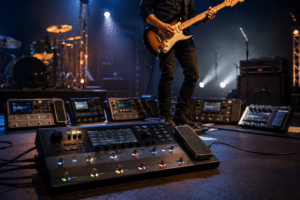
If you’re playing live, your tone needs to do more than sound good in your bedroom. It has to be reliable, easy to control on stage, and flexible enough to handle clean parts, crunchy rhythm tones, solos, ambient swells, acoustic-style patches, and maybe even bass or backing-track duties.
That’s where a great multi-effects pedal can completely change your gigging life.
Instead of carrying a pedalboard the size of a coffee table, multiple power supplies, patch cables, amp heads, and a “please don’t fail tonight” attitude, a modern multi-effects unit can give you amp models, effects, cabinet simulation, routing, MIDI control andUSB recording in one box.
But here’s the catch: not every unit is right for every player.
A beginner playing weekend worship sets probably doesn’t need the same monster rig as a session guitarist running stereo amps, MIDI automation, and complex snapshots. So in this guide, we’ll break down the 10 best multi-effects pedals for gigging musicians of all levels, from affordable workhorses to full-blown professional stage command centers.
What Makes a Multi-Effects Pedal Great for Gigs?
Before we dive into the list, let’s talk about what actually matters on stage.
A gigging multi-effects pedal should offer:
- Reliable footswitching for changing sounds quickly
- Good amp and cab tones direct to PA or FRFR speaker
- Easy preset organization for setlists
- Solid build quality for real-world stage abuse
- Enough inputs and outputs for your setup
- Expression pedal support for wah, volume, pitch, or delay mix
- Fast editing so you’re not menu-diving during soundcheck
- Consistent volume levels between patches
That last one is huge. A killer lead tone is useless if it’s accidentally twice as loud as your clean patch.
For live use, the “best” multi-effects pedal is the one that lets you focus on playing , not troubleshooting.
1. Kemper Profiler Stage: Best for Players Who Want Real Amp Profiles
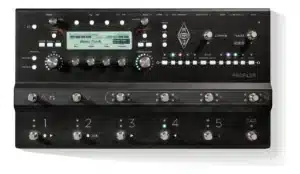
The Kemper Profiler Stage is a favorite among touring guitarists for one big reason: it doesn’t just model amps in the traditional sense , it uses profiling, which captures the sound and response of real amps, cabinets, and mic setups.
If you love the idea of taking a perfectly mic’d tube amp tone to every gig without carrying the amp, the Kemper Stage is a serious weapon.
Best for: Intermediate to professional players
Strengths: Amp profiling, live reliability, massive profile library
Watch out for: Editing can feel less immediate than some touchscreen-based units
For example, if you want a cranked Marshall-style rhythm tone for classic rock, a sparkling Fender-style clean, and a modern high-gain profile for metal, you can load them all into one performance and switch between them easily.
The Kemper Stage is especially strong if you already know what amp sounds you love and want to reproduce them consistently night after night.
2. Fractal Audio FM9: Best Premium Tone Machine for Serious Players
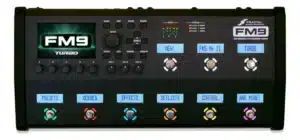
The Fractal FM9 is one of the most powerful floor processors available. Fractal’s amp modeling has a reputation for being extremely detailed, dynamic, and “amp-like” under the fingers.
This is the kind of unit that makes tone tweakers very happy. You can build simple rigs, but you can also go deep , dual amps, complex routing, studio-quality effects, MIDI control, and detailed cabinet options.
Best for: Advanced players, session musicians, touring guitarists
Strengths: World-class amp tones, deep editing, excellent effects
Watch out for: Can be overwhelming for beginners
Want a rig with a Deluxe Reverb-style clean, a Plexi crunch, a 5150-inspired lead tone, stereo delays, and a shimmer reverb for ambient intros? The FM9 can handle it without breaking a sweat.
If you’re the kind of guitarist who hears a tiny difference between two virtual power amp settings, congratulations , the FM9 may be your happy place.
3. Neural DSP Quad Cortex: Best Modern Touchscreen Experience
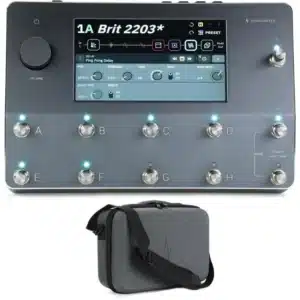
The Quad Cortex by Neural DSP is sleek, powerful, and extremely popular with modern guitarists. It features high-quality amp models, effects, and Neural Capture, which lets you capture amps, pedals, and rigs in a way similar to profiling.
One of its biggest advantages is the user interface. The touchscreen makes building a signal chain feel more like using a smartphone than programming a spaceship.
Best for: Intermediate to professional players
Strengths: Touchscreen workflow, compact size, captures, great tones
Watch out for: Expensive, and some players may want more traditional footswitch layouts
For gigging musicians, the Quad Cortex shines when you need a compact but powerful board. You can run direct to front-of-house, send a separate signal to your stage monitor, and organize presets for different songs.
It’s especially popular in modern worship, pop, metal, and session-style setups where polished, direct tones are essential.
4. Line 6 Helix Stadium XL Floor: Best Next-Generation Stage Workstation
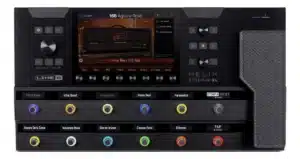
The Line 6 Helix Stadium XL Floor takes the Helix concept into a new generation. It brings updated amp modeling, a large high-resolution touchscreen, advanced routing, modern connectivity, and a performance-focused layout.
Line 6 has always been strong in the gigging world because their units are practical. The original Helix became a stage staple because it was powerful but still understandable. The Stadium XL Floor pushes that idea further with a more modern interface and serious live-control features.
Best for: Pro players, tech-heavy performers, modern live rigs
Strengths: Big touchscreen, flexible routing, strong ecosystem, stage control
Watch out for: Premium price and plenty of features to learn
This is a great option if your multi-effects pedal is not just your guitar rig, but the center of your entire stage setup.
Think stereo guitar tones, MIDI-controlled changes, setlist-based presets, direct recording, backing-track integration, and deep live control. It’s not the simplest choice, but for players who need a command center, it’s very exciting.
5. Valeton GP-200: Best Budget-Friendly Gigging Option
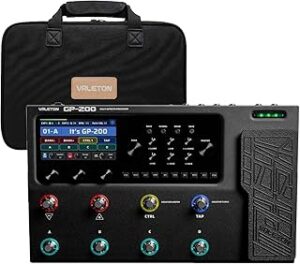
The Valeton GP-200 is proof that you don’t need to spend flagship money to get a very usable live rig. It offers amp modeling, effects, cab simulation, an expression pedal, and enough control for many real-world gigs.
Is it going to replace a high-end Fractal or Kemper for a touring pro? Probably not. But for beginners, weekend warriors, cover-band players, and budget-conscious musicians, it delivers a lot for the money.
Best for: Beginners to intermediate players
Strengths: Affordable, compact, good feature set
Watch out for: Amp realism and effects depth may not match premium units
A practical example: you could set up four core patches:
- Clean chorus for pop and funk
- Edge-of-breakup crunch for blues and country
- High-gain rhythm for rock and metal
- Lead boost with delay for solos
That’s enough to survive a huge number of gigs.
6. HOTONE Ampero II Stage: Best Compact Dual-Chain Performer
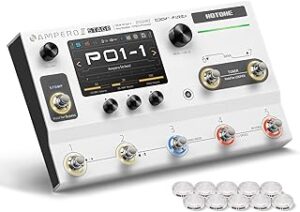
The HOTONE Ampero II Stage is a compact but surprisingly capable multi-effects pedal. It offers dual effect chains, an effects loop, MIDI, and a modern interface that works well for players who want flexibility without carrying a huge board.
The dual-chain setup is especially useful if you want to run more complex rigs , for example, one path for a direct amp tone and another path for ambient effects, acoustic simulation, or bass processing.
Best for: Intermediate players, compact-rig fans, stereo users
Strengths: Dual chains, MIDI, FX loop, portable size
Watch out for: Smaller footprint means fewer dedicated footswitches than larger boards
This is a great choice for gigging musicians who play in smaller venues, travel light, or need a flexible backup rig.
If your main rig goes down, having an Ampero II Stage in your bag could save the night.
7. Line 6 POD Go: Best Beginner-to-Intermediate Live Pedal
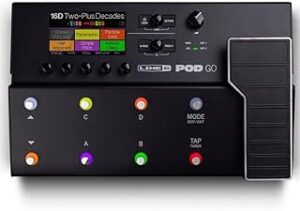
The Line 6 POD Go is one of the easiest recommendations for players who want great tones without getting buried in advanced routing.
It uses Helix-family sounds in a more streamlined format. You get amp models, effects, cab simulation, snapshots, an expression pedal, and a layout that makes sense quickly.
Best for: Beginners to intermediate gigging players
Strengths: Easy to use, great value, strong sounds
Watch out for: Less routing flexibility than full Helix units
If you’re playing your first gigs and want to go direct to the PA, the POD Go is a smart choice.
8. BOSS GX-100: Best Touchscreen Multi-Effects for Working Players
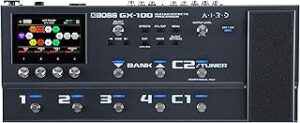
The BOSS GX-100 brings BOSS reliability into a more modern touchscreen-based format. It uses BOSS’s AIRD technology, which is designed to make amp and speaker behavior feel more natural, especially when playing through different output systems.
BOSS gear has a reputation for surviving years of gigs, rehearsals, van rides, and questionable stage power. The GX-100 feels like a practical tool for real musicians.
Best for: Beginner to advanced players
Strengths: Touchscreen, reliable build, great effects, good value
Watch out for: Some players may prefer other brands for amp modeling flavor
The effects are a major highlight. BOSS delays, choruses, reverbs, compressors, and drives have been used on countless records and stages.
If you play covers, church gigs, bar shows, or function-band sets, the GX-100 gives you a lot of useful sounds without needing a PhD in digital routing.
9. MOOER GE300: Best Feature-Packed Alternative for Creative Players
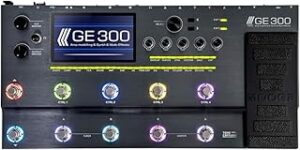
The MOOER GE300 is a powerful multi-effects unit with amp modeling, effects, synth features, tone capture, and flexible routing. It’s a strong option for players who want a lot of creative tools without jumping into the highest price tier.
One standout feature is its synth-style capability, which can be fun for experimental players, modern worship textures, ambient music, or adding unusual layers to live parts.
Best for: Intermediate to advanced players
Strengths: Lots of features, creative sounds, tone capture
Watch out for: Interface and tones may require tweaking to get the best results
For example, if your band plays modern pop covers, you could use the GE300 to create guitar parts that mimic synth pads, octave textures, or processed lead sounds.
10. BOSS GT-1000: Best Road-Ready Professional BOSS Flagship
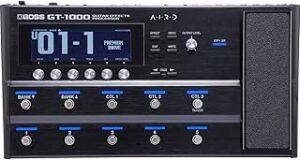
The BOSS GT-1000 is the flagship option from BOSS and remains a serious choice for gigging musicians who want durability, professional effects, advanced routing, and strong live performance features.
Compared with the GX-100, the GT-1000 is more powerful and more performance-oriented. It’s built for players who need a dependable main rig for regular gigs.
Best for: Intermediate to professional players
Strengths: Pro build, excellent effects, advanced control, low latency feel
Watch out for: Editing can feel less immediately friendly than touchscreen-heavy units
The GT-1000 works well if you want a polished, direct live rig with BOSS reliability. It’s especially strong for players who use a mix of traditional guitar tones and modern effects.
If your set goes from clean funk to classic rock to ambient ballads to high-gain solos, the GT-1000 can cover the ground confidently.
Quick Buying Guide: Which Multi-Effects Pedal Should You Choose?
Here’s the short version if you’re still deciding.
Best for Beginners
- Line 6 POD Go
- Valeton GP-200
- BOSS GX-100
These are easier to learn, more affordable, and still gig-ready.
Best for Intermediate Players
- HOTONE Ampero II Stage
- MOOER GE300
- BOSS GX-100
- Line 6 POD Go
Great if you already understand presets, effects order, and basic live routing.
Best for Pros
- Kemper Profiler Stage
- Fractal FM9
- Neural DSP Quad Cortex
- Line 6 Helix Stadium XL Floor
- BOSS GT-1000
These are built for serious live work, deep editing, and professional consistency.
Best for Amp Purists
Choose the Kemper Profiler Stage if you want captured real amp tones, or the Fractal FM9 if you want incredibly detailed amp modeling.
Best for Modern Workflow
Choose the Quad Cortex or Helix Stadium XL Floor if touchscreen editing and modern routing matter to you.
Best Value
The Line 6 POD Go, Valeton GP-200, and BOSS GX-100 are hard to beat for the money.
Live Gig Tip: Build Fewer, Better Presets
Here’s a mistake almost every guitarist makes at some point: building 47 presets and using completely different amps, cabinets, EQ settings, and effects on every song.
It sounds fun at home. Live, it can become chaos.
For most gigs, you’re better off building a small set of reliable core sounds:
- Clean
- Clean with modulation
- Crunch
- Heavy rhythm
- Lead
- Ambient/special effect
Then use snapshots, scenes, or footswitch assignments to add boosts, delay, reverb, or modulation.
Your sound engineer will thank you. Your band will thank you. Your future self, standing on a dark stage trying to fix volume jumps mid-song, will definitely thank you.
Conclusion: The Best Multi-Effects Pedal Is the One That Helps You Play Better
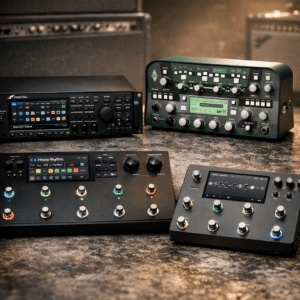
The best multi-effects pedal for gigging musicians isn’t always the most expensive one. It’s the one that fits your level, your music, your budget, and your stage needs.
Whatever you choose, remember this: tone matters, but confidence matters more. Learn your unit, level your presets, rehearse with your live setup, and make sure you can switch sounds without staring at the floor like you’re decoding ancient runes.
Now grab your guitar, build a killer live preset, and test it at stage volume.
Have you gigged with any of these multi-effects pedals? Share your experience in the comments , and check out our next guide on 7 Best Electric Guitars for Beginners Under $400
Enjoyed this article? Continue your guitar evolution by reading our next guide:
Top 5 Guitar Amplifiers for Home Practice